SME funding · What it means for you
R5.4 billion is heading to South African SMEs. Here’s what it means for your business
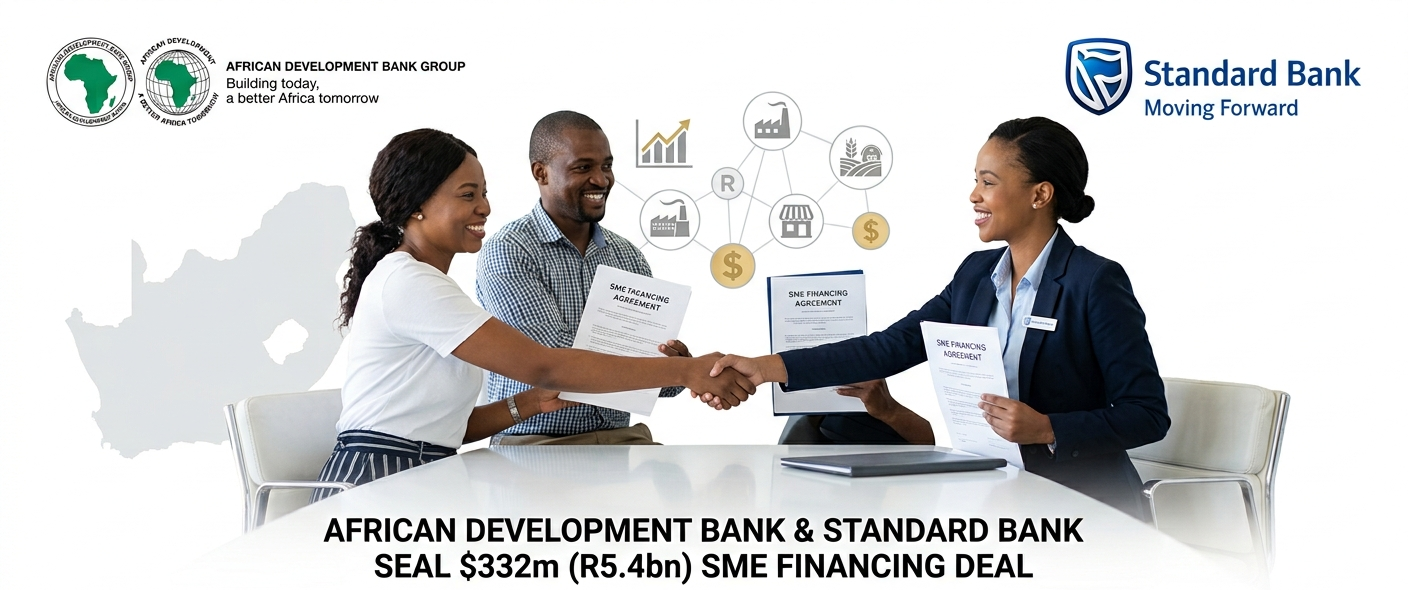
The African Development Bank has put R5.4 billion into Standard Bank to lend to small businesses, plus R16 million in grant support for women-led firms. We read the announcement so you can act on it.
On 31 July 2026 the African Development Bank and Standard Bank Group announced two transactions aimed squarely at South African small businesses. Most coverage will stop at the headline number. The useful information is further down the page — particularly which businesses the last round of this money actually reached.
01What was announced
Two separate things, and it helps to keep them apart.
- A R5.4 billion (US$332 million) investment by the African Development Bank into a capital markets security issued by Standard Bank Group. Standard Bank has committed to allocating the full amount to SMEs across South Africa, including women-led businesses.
- A R16 million (US$1 million) technical assistance grant through the Bank’s AFAWA programme — Affirmative Finance Action for Women in Africa — funded from the We-Fi window, aimed at the barriers women entrepreneurs face.
The first is debt: money Standard Bank will lend on and expect back. The second is grant funding for support services, not cash to businesses. Together, in the Bank’s framing, they expand Standard Bank’s capacity to finance SMEs.
Announced together, doing different jobs. Only the first is money you could borrow. The second buys support that makes businesses more fundable.
02The most useful line in the whole announcement
Near the bottom, the Bank reports on the previous facility. In November 2024 it approved a R3.6 billion subordinated debt facility for Standard Bank. As at December 2025, that facility had been fully utilised, supporting 5,425 SMEs — against an initial target of 4,000.
And crucially, it names where the loans went: agriculture, retail, wholesale trade, and manufacturing.
Two things an entrepreneur can use: this money gets deployed rather than announced and forgotten, and it has a track record of going to trading businesses in four specific sectors.
If you run a farm, a shop, a wholesale operation or a small manufacturing business, that sector list is the single most relevant sentence in the announcement. It tells you the lender is already comfortable with businesses like yours.
03What size of business is this for?
The announcement doesn’t say directly, but it gives you the two numbers you need to work it out. R3.6 billion reached 5,425 businesses. That is an average of roughly R664,000 per business.
Our calculation from the two figures in the announcement, not an official target. Individual loans will range widely around this average.
That number tells you the shape of borrower this lending is built for. It is not micro-finance, and it is not startup capital. It reads like a growth or working-capital loan to an established, trading, already-banked business — the kind that needs a vehicle, a machine, stock, or bridging on a contract.
04How would you actually get any of it?
This is where most reporting leaves readers stranded, so let’s be direct.
Four steps from the African Development Bank to a loan in a small business. Only the last one involves you.
What changes is capacity, not criteria. A bank with more funding available for SME lending is a bank with more appetite to say yes to borderline applications, and more reason to go looking for qualifying businesses. That is a real advantage — but it accrues to businesses that are ready when asked, not to businesses that hear about a facility and hope.
What to have ready before you approach any lender
Five things
- 1Annual financial statements for the last two years, and management accounts no older than a quarter.
- 2Six to twelve months of business bank statements — from an account in the business’s name, separate from personal.
- 3A valid tax clearance certificate and CIPC registration in good standing.
- 4A specific amount tied to a specific purpose. “R650,000 for a delivery vehicle that services a signed R2.4 million contract” is fundable. “R650,000 for growth” is not.
- 5Evidence of the revenue that repays it — contracts, purchase orders, or a demonstrable trading history.
None of this is specific to this facility. All of it is what separates an approved application from a declined one.
05If you are a woman-led business, read this part twice
The R16 million AFAWA grant is small next to R5.4 billion, but it targets something more stubborn than a shortage of capital.
According to the announcement, it funds digital payment tools that help businesses build verifiable credit histories, alongside enterprise and supplier development support for women-led SMEs. Standard Bank’s Bill Blackie framed it as funding initiatives with direct, tangible benefits for women-led businesses looking to start, manage and grow.
Why does the credit-history piece matter so much? Because a great many viable small businesses are declined not for being bad risks but for being unreadable ones. If your turnover moves in cash and your records live in a notebook, a bank has nothing to assess. Move that same turnover through a digital payment tool for a year and you have created something no reference letter can substitute for: a verifiable record of real revenue.
06The jargon, briefly, then we’ll move on
The announcement describes the investment as a Flac instrument issued as a social bond listed on the JSE, and notes it is Africa’s first development-finance-supported social Flac instrument on the Exchange.
In plain terms: Flac stands for First Loss After Capital. It is a new class of bank debt introduced by the South African Reserve Bank in January 2026, part of a phased move to a formal bank resolution regime. The “social bond” label means the proceeds are ring-fenced for a stated social purpose — here, SME lending. Standard Bank had not previously issued a Flac instrument on the JSE targeting a social use of proceeds.
What it means for your loan application: nothing. It matters because it explains why the money is committed to SMEs rather than general lending, and it is the reason the commitment is public and measurable. Beyond that, you can ignore it.
07This is a relationship, not a one-off
The announcement notes the partnership between the two institutions dates back to 2008. The current deal builds directly on November 2024, when the Bank approved the R3.6 billion facility alongside a US$200 million risk participation agreement with The Standard Bank of South Africa supporting trade finance across Africa.
Why the history matters: a lender that has done this before, hit its numbers, and come back for a larger round is a lender likely to keep lending.
For an entrepreneur, that pattern is the point. This is not a pilot that may quietly disappear. It is the third step in a sequence, and the previous step over-delivered.
08What the announcement doesn’t tell you
Being straight about the gaps is more useful than pretending they aren’t there.
| What is missing | What we know instead |
|---|---|
| No SME target for the new facility | The 4,000 target belonged to the 2024 round. Nothing equivalent has been published this time. |
| No sector split | We know the four sectors the previous loans went to, not how the money divided between them. |
| No pricing, tenor or qualifying criteria | Interest rates, loan terms and eligibility remain Standard Bank’s commercial decisions. |
| No timeline for deployment | The last facility took roughly thirteen months to fully utilise, which is a reasonable guide but not a commitment. |
| No detail on how AFAWA support is accessed | The activities are described; the route in is not. Ask the business banking team by name. |
09Who said what
| Speaker | Role | The substance |
|---|---|---|
| Kennedy Mbekeani | AfDB Director General, Southern Africa and Country Manager for South Africa | Frames the deal as directing long-term capital to small businesses while strengthening the banking system |
| Luvuyo Masinda | Chief Executive, Corporate and Investment Banking, Standard Bank Group | Notes South Africa has roughly 3.2 million SMEs accounting for 60% of jobs, and calls access to finance imperative |
| Bill Blackie | Chief Executive, Business and Commercial Banking, Standard Bank | Highlights the technical assistance grant and its direct benefit to women-led SMEs |
| Ahmed Attout | Director, Financial Sector Development, AfDB | Describes the transaction as catalytic, intended to encourage wider adoption of banking best practice in Africa |
10The bottom line
R5.4 billion is real, it is committed in full to SMEs, and the same partnership delivered ahead of target last time.
If your business trades in agriculture, retail, wholesale or manufacturing, turns over enough to service something in the region of half a million rand, and can produce clean financials and bank statements, you are in the population this money is looking for.
If you are not there yet, the work is unglamorous and entirely within your control: separate your accounts, run your revenue through channels a lender can read, keep your statements current, and know exactly what you would borrow and why.