Part 1 of 8 · Start here
Business Ideas Pretoria South Africa 2026
Twenty businesses to start in the capital — and why the barrier here is a credential, not capital. Pretoria is not a smaller Johannesburg with government attached. It is a fundamentally different kind of economy, and businesses succeed here for reasons that do not apply fifty kilometres south.
How to use thisRead Part 2 before the list
This guide makes one central argument, sets out the evidence for it, and then applies it to twenty specific businesses. Each entry states what it costs, what it earns, how long the credential takes, what will kill it, and how to land the first contract.
The argument in Part 2 — the accreditation moat — is the most commercially valuable page in this document, and the twenty entries are simply that argument applied. If you read only the list, you will pick the wrong business.
Section 1The economic anatomy
The City of Tshwane houses roughly 4.04 million people as at the 2022 census, contributes about 26.8 per cent of Gauteng’s GDP and around 9.4 per cent of national GDP, and is the largest metropolitan municipality in South Africa by land area.
Source: Statistics South Africa, City of Tshwane municipal profile. Different official sources classify these categories slightly differently — the municipality’s own IDP puts community services at 35.2% and finance at 25% on a different basis — but the conclusion is stable across all of them.
Compare that to Johannesburg, where finance and commerce dominate, or Ekurhuleni, where manufacturing and logistics do. Pretoria’s largest single economic activity is the business of governing, and its second is the professional services that cluster around institutions. Manufacturing matters, but it is concentrated and specific: metal products, machinery and, above all, motor vehicles.
Section 2The six institutional buyers
Almost every durable business in Pretoria sells to one of six institutional buyers. What they share is more important than what distinguishes them: each has a budget set by statute or by a global parent, each procures through a formal gate, and none of them can move.
The seat of the executive cannot relocate, embassies follow the seat of government, the universities own their campuses, and the automotive OEMs have sunk many billions of rand into plant at Rosslyn and Silverton.
- National government. The Union Buildings and the head offices of every national department. This is the largest procurement pool in the country and it is administered from Pretoria.
- The diplomatic corps. Pretoria hosts the second-largest concentration of embassies and high commissions in the world after Washington DC. Each is a self-contained procuring entity with hard-currency budgets, unusual requirements and almost no local suppliers who understand them.
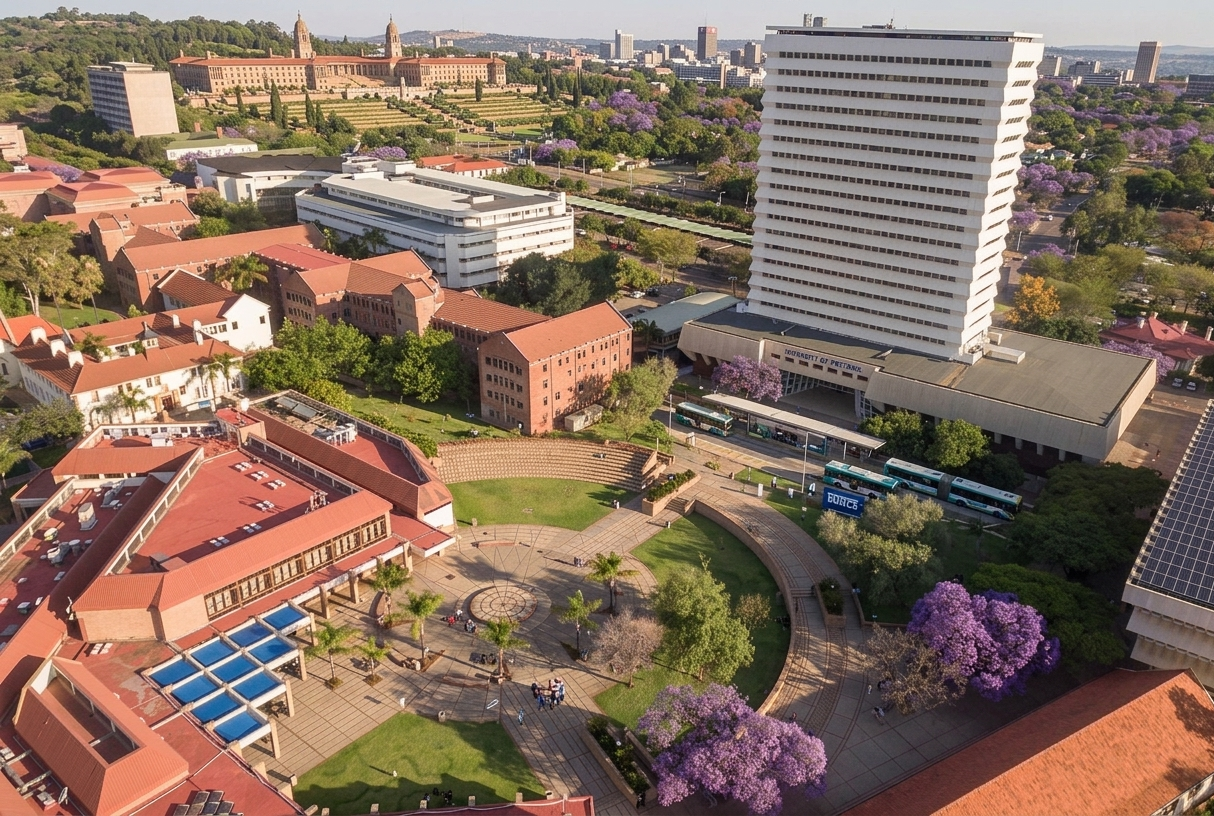
- The universities. The University of Pretoria, UNISA, the Tshwane University of Technology and Sefako Makgatho Health Sciences University. TUT alone enrols roughly 60,000 students; UP admitted about 9,700 first-years for 2026 alone.
- The research councils. The CSIR, Agricultural Research Council, HSRC, NRF, Water Research Commission, Necsa, Council for Geoscience and Onderstepoort Veterinary Institute — the densest concentration of publicly funded research capacity on the African continent.
- The automotive OEMs. BMW and Nissan at Rosslyn, Ford at Silverton. Ford invested roughly R16 billion at Silverton between 2020 and 2023 and a further R5.2 billion from 2024 to 2026, with Silverton now the global production hub for the Ranger PHEV and Rosslyn the sole global site for the BMW X3 30e xDrive PHEV. Nissan announced in January 2026 an intended sale of the Rosslyn plant to Chery South Africa, subject to regulatory approval.
- Defence and state-owned entities. SANDF headquarters, Armscor, Denel and the head offices of numerous state agencies, all procuring under their own regimes.
Section 3The Johannesburg shadow: what not to build
This is the mistake that traps ambitious founders in Pretoria. They observe a wealthy, educated city of four million people and build a business that would work in Sandton — a boutique consultancy, a premium retail concept, a corporate events agency — and then discover that the client base they imagined is headquartered an hour down the N1, buys from suppliers it already knows there, and treats Pretoria as a branch market.
The businesses that thrive in Pretoria are the ones Johannesburg cannot take. Government does not move. Embassies follow the seat of government. A university cannot relocate its campus. Ford cannot pick up Silverton.