Part 3 · Funder directory
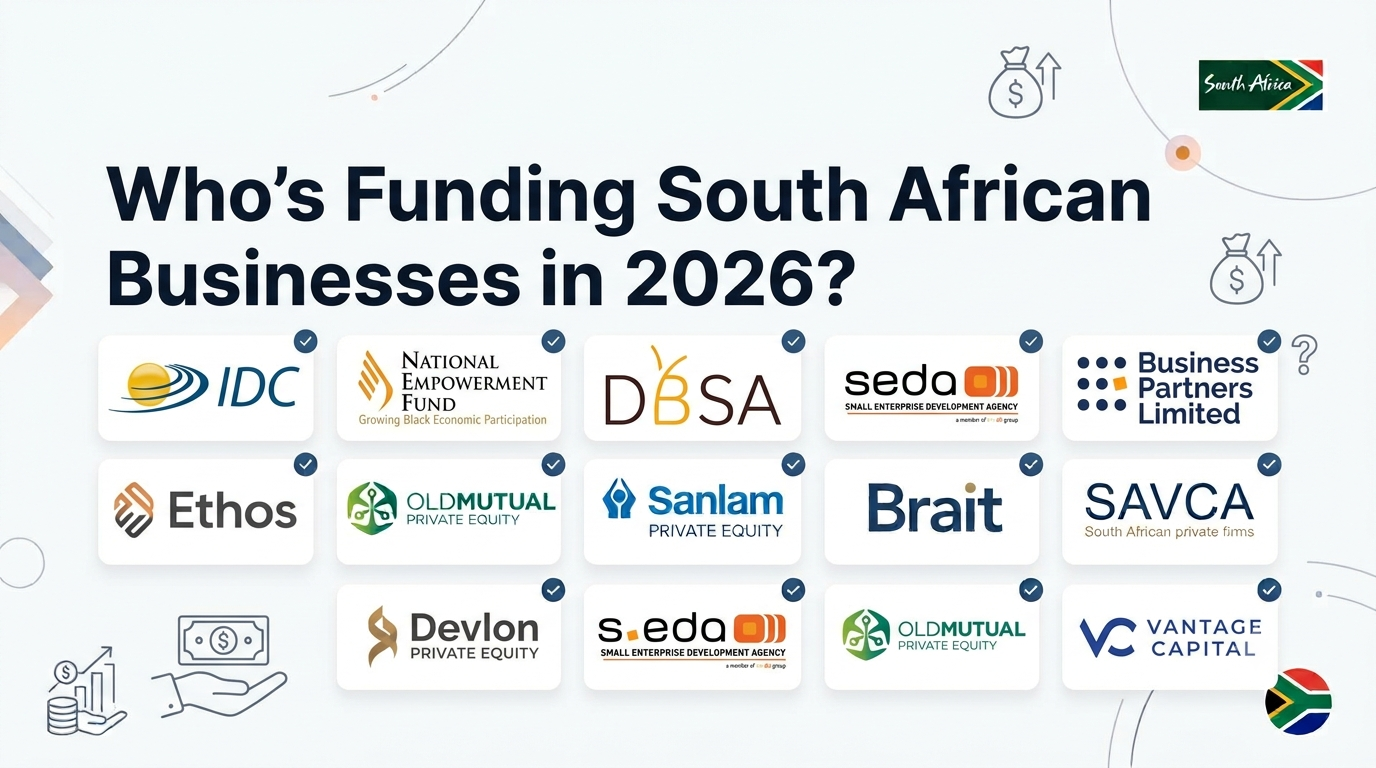
Government Funders: SEDFA, IDC, NEF, the dtic, NYDA & More
Government agencies and state DFIs are the deepest pool of accessible business funding in South Africa — and the most mandate-driven. Each profile below carries the practical detail funders’ own brochures omit: realistic timelines, approval odds and the success tips that separate funded applications from the declined pile.
Government agencies & programmes
Small Enterprise Development Finance Agency (SEDFA)
South Africa’s primary government agency for SMME support. One application now covers finance (former sefa mandate), business development support (former Seda) and co-operative banking (former CBDA). Annual allocation exceeds R2bn. 2026 priority programmes include the Township & Rural Entrepreneurship Programme, Women’s and Youth Entrepreneurship Funds, Spaza Shop Support Fund, CreativeBiz Nexus, the Small Manufacturer Development Support Programme and the JSE SME RISE capital-matching initiative.
Who qualifies: SA-registered SMME or co-op, majority SA-owned; tax compliant; viable business case; owner contribution encouraged
Documents: CIPC documents, certified IDs, 6–12 months bank statements, management accounts/AFS, tax clearance PIN, business plan with cash flow forecast, quotations for asset purchases
Industrial Development Corporation (IDC)
South Africa’s largest DFI. Provides loans, equity, quasi-equity and guarantees to projects that build industrial capacity, localise production, replace imports, grow exports and create jobs. No general grant products (repayable capital only), though it administers third-party funds. Anchor funder for renewable energy, mineral beneficiation, agro-processing and manufacturing value chains.
Who qualifies: Economic merit + development outcomes (jobs, localisation, transformation); startups need ~50% owner equity at peak vs ~35% for expansions; security taken where available
Documents: Full business plan, 3–5 yr financial model, off-take/market evidence, EIA/licences where relevant, B-BBEE certificate, AFS, technical studies
National Empowerment Fund (NEF)
Funds black-empowered businesses across the lifecycle via iMbewu (startups), uMnotho (expansion & acquisitions), rural & community development, and women- and youth-focused windows. Instruments span debt, mezzanine and equity, with a strong appetite for acquisition/management-buy-in transactions that transfer ownership to black entrepreneurs.
Who qualifies: Majority black ownership and operational involvement; commercially viable; owner contribution (typically 2.5–10%); tax compliant
Documents: Business plan, AFS/management accounts, sale/franchise agreements for acquisitions, personal statements of assets & liabilities, tax clearance, B-BBEE evidence
the dtic — incentives portfolio
The Department of Trade, Industry and Competition runs South Africa’s flagship grant machinery: the Black Industrialists Scheme (BIS), Manufacturing Support Programme (MSP), Agro-Processing Support Scheme (APSS), Automotive Investment Scheme family (AIS/P-AIS/MHCV-AIS), innovation incentives (SPII, THRIP), export promotion (EMIA), Critical Infrastructure Programme (CIP) and the SEZ tax package. From 1 June 2026 all applications route through the new Online Incentive Solution (OIS) platform.
Who qualifies: Registered SA manufacturers/qualifying entities; project must be new investment or expansion (apply BEFORE spending); B-BBEE and ownership thresholds per scheme; co-funding evidence required (BIS requires a matching co-funder)
Documents: OIS online application, business plan, 3-yr projections, quotes for qualifying assets, AFS, tax clearance, B-BBEE certificate, co-funder term sheet
National Youth Development Agency (NYDA)
Provides non-repayable grants from R1,000 to R250,000 (higher tiers for agriculture and technology projects) to businesses 100% owned by South Africans aged 18–35, plus business vouchers of R6,600–R19,800 for professional services, mandatory business management training, mentorship and market linkages.
Who qualifies: SA citizens aged 18–35; business 100% youth-owned and operating in SA; full-time involvement; completion of NYDA Business Management Training; tax registration where applicable (clearance not required under R200k)
Documents: ID, CIPC registration (for entities), quotations for items to be funded, bank confirmation, training certificate, simple business plan
Technology Innovation Agency (TIA)
Bridges the gap between R&D and commercialisation. Instruments include the Seed Fund (early-stage technology validation, typically up to ~R1m via university/incubator channels), Technology Development Fund and commercialisation support for prototypes, IP protection, certification, pilots and market testing.
Who qualifies: SA entity with defensible technology IP beyond pure concept; technical team credibility; route-to-market articulated
Documents: Technology description & TRL evidence, IP status, development budget, team CVs, commercialisation plan, entity documents
Land and Agricultural Development Bank (Land Bank)
Specialist agricultural financier offering production loans, instalment sale asset finance, term loans for land and improvements, and blended-finance schemes with the Department of Agriculture that embed grant portions for black producers. Emerged from its 2020 default with a completed liability restructure and is re-building its development book.
Who qualifies: Bankable farming operation or credible ramp-up plan; collateral (land, movables, crop liens); water rights and off-take strengthen cases
Documents: Farm business plan, production budgets, historical yields, off-take agreements, title deeds/lease, AFS, tax clearance
Export Credit Insurance Corporation (ECIC)
Insures South African exporters and their banks against political and commercial risk on medium/long-term export contracts and cross-border investments — the enabling layer that lets banks fund capital-goods exports and construction contracts into the rest of Africa and beyond.
Who qualifies: SA content thresholds in the export contract; bankable buyer/borrower; environmental & social compliance
Documents: Export contract, buyer financials, financing term sheet, SA-content calculation, ESG documentation
Department of Small Business Development (DSBD)
Owns SMME and co-operative policy, the National Small Enterprise Amendment Act architecture, and programme funding routed through SEDFA — including township & rural enterprise support, the Spaza Shop Support Fund and co-operative development grants. Businesses generally access DSBD money through SEDFA rather than the department directly.
Who qualifies: Programme-specific (e.g. township location, spaza registration, co-op membership rules)
Documents: As per SEDFA checklists; municipal trading permits for informal/spaza programmes
Department of Science, Technology & Innovation / NRF
Funds research, technology development and innovation via the NRF (research grants, THRIP-adjacent industry-academy collaboration), sector innovation funds and the R&D tax incentive (s11D, 150% deduction on qualifying R&D). Businesses typically engage through partnerships with universities, science councils or via TIA.
Who qualifies: Research merit, SA-based R&D, collaboration structures; s11D requires pre-approval of R&D activities
Documents: Research proposal, budgets, collaboration agreements, s11D application before R&D commences
SANEDI & energy-sector programmes
The South African National Energy Development Institute drives applied energy RD&D, energy-efficiency programmes (including 12L tax-incentive measurement legacy and current EE support), cool-surfaces and workstreams supporting the Just Energy Transition. Funding is programme/call-based rather than a standing loan window.
Who qualifies: Alignment with published calls; technical credibility
Documents: Call-specific proposals and budgets
Provincial development agencies (GEP, ECDC, KZN Growth Fund, Casidra, FDC, LEDA)
Each province runs its own funding machinery: Gauteng Enterprise Propeller (loans & business support), Eastern Cape Development Corporation, KZN Growth Fund (mid-cap project debt), Casidra (Western Cape agri), Free State FDC, Limpopo LEDA and others. Terms are often softer than national DFIs for in-province projects, with local-content and jobs mandates.
Who qualifies: In-province operations; provincial priority alignment; standard viability tests
Documents: Standard SME pack + provincial-programme forms
The Jobs Fund (National Treasury)
A National Treasury challenge fund awarding matched grants through competitive funding rounds to projects with demonstrable job-creation models — enterprise development, infrastructure unlocks, support for work-seekers and institutional capacity. Grants are catalytic and performance-based, disbursed against contracted job milestones.
Who qualifies: Co-funding (typically 1:1 for private applicants), credible jobs model, M&E capacity
Documents: Full proposal, co-funding evidence, jobs model & M&E framework, organisational financials
National Film & Video Foundation (NFVF)
Funds development, production, post-production and marketing of South African film and television content, plus training bursaries and festival participation — the sector’s grant backbone alongside the dtic’s production rebates (25–35% of qualifying spend).
Who qualifies: SA citizens/companies; category-specific criteria; previous-work portfolio weighs heavily
Documents: Script/treatment, budget, finance plan, key-team CVs, chain of title
Scores (1–10) blend accessibility, funding depth, pricing softness and observed approval behaviour — how the institution actually behaves, not how its brochure reads. An 8 means a well-prepared, mandate-aligned applicant has genuinely strong odds; a 5 means the money is real but competitive or slow.